Amplifying The Central Nervous System
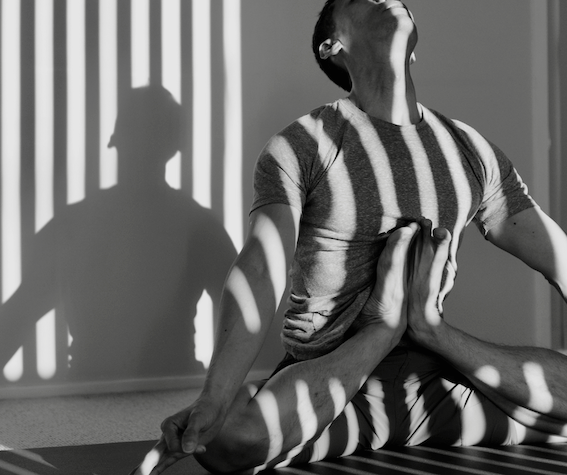
Kandasana is a powerful yoga posture that works on the kanda nadi, an important energy centre in the lower abdomen and pelvis. This nadi is the root from which three key energy channels – Muladhara, Svadhisthana, and Manipura – arise. It not only supports reproductive health but also plays a role in awakening higher brain functions. With consistent practice, it helps activate Kundalini, deepens meditation, and expands inner awareness.
This process takes time, often years and requires patience. Learning from a teacher is ideal, but if practising alone, it’s important to go slowly. The body and nervous system need time to adjust to the intense energy shifts. I learned Kandasana on my own, and it took years to unfold. Even now, while it remains one of the postures I practise the most, it remains as challenging as the first time.
The mind always wants to move fast, but yoga teaches us to slow down and be more present in our bodies. With greater awareness, we gain clarity, wisdom, and inner stability. True discipline isn’t about force – it’s about balance and resilience and consistency.
Kundalini energy rests at the base of the kanda nadi, just above the front of anus. This is where deep layers of our consciousness lie. To experience its awakening, one must step onto this path, face the subconscious, overcome inner challenges, and return safely. When Kundalini rises, it generates an immense surge of energy in the body. If unprepared, the nervous system can become overwhelmed, leading to instability. That’s why the ancient yogis always emphasised a steady, slow approach – allowing the body to grow stronger, and ready for transformation.
Kandasana: Where It All Begins
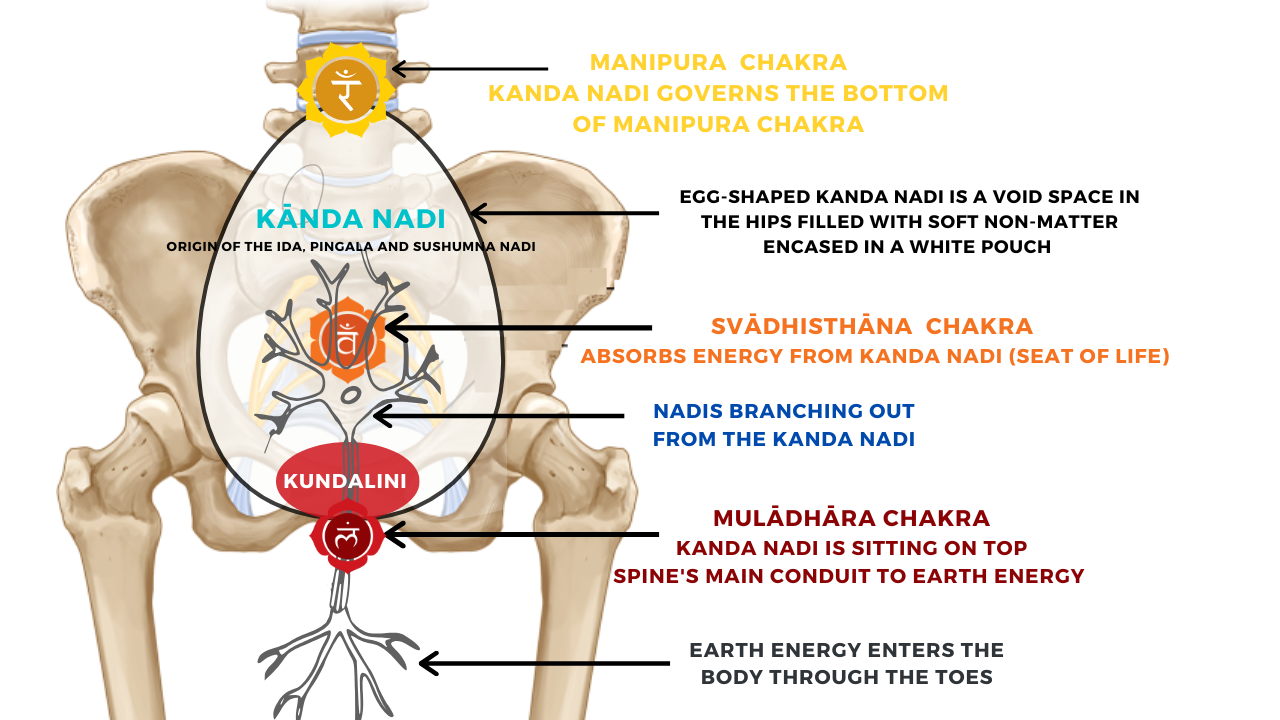
Hovering just above the pelvic floor within the hips is a soft, cloud-like essence enclosed in a white sheath – this is the Kanda Nadi. ‘Kanda’ means ‘root,’ as it is the origin point from which the three primary nadis – Ida, Pingala, and Sushumna – emerge. The body of the kanda nadi occupies most of the generative organs and it terminates at the level of the navel.
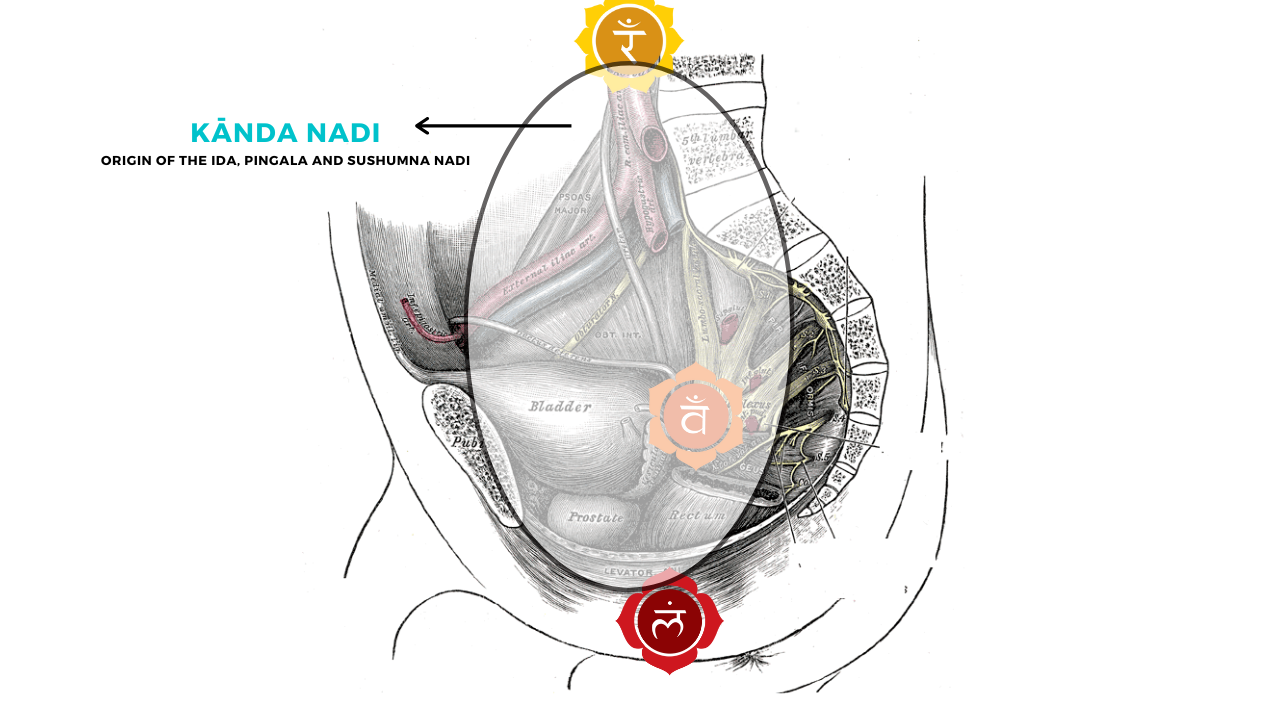
Initial absorption of energy into the nadis happen in the kanda nadi. It is important for the healthy function of organs in the pelvic cavity. In particular, the reproductive glands are energised and rejuvenated. That is the reason why the kandasana could be a powerful technique for treating issues of the reproductive system, especially in males
The kanda nadi is not physical. It is only active in the subtle body. It is a tunnel in the pelvic cavity where energy pervades. Picture a whirlpool or a vortex. The nerve impulses from the sacrum and lumbar spine (L4 – S4) are being released into this ‘energetic pouch’. It pervades three important astral and energetic centres in the pelvis; the muladhara, svadhisthana and manipura chakras. The reservoir of energy forms a soft, white, ‘egg-shaped’ floating substance inside the hips.
People who cannot do the kandasana can practice the siddhasana (for males) or siddha yoni asana (for females). Additionally, pranayama, kumbhaka and mudra, can activate the kanda nadi. In turn, the CSF in the lumbar cistern is magnetised, so that when it goes back up to the brain, it carries a higher level of electricity resulting in the stimulation of the entire central nervous system. The kanda nadi radiates a bluish radiance when it is brimming with energy.
Kanda Nadi: The Dormant Power
The Kanda Nadi is so subtle that it’s almost impossible to feel, yet it spans a large area within the hips, covering most of the pelvic cavity. It plays a crucial role in developing our energetic system – everything begins here.
The kanda nadi often goes unnoticed, especially since the Manipura Chakra, located just above it, is stronger and more active. This can lead to confusion, with many thinking that the three main nadis – Ida, Pingala, and Sushumna, originate from Manipura. Personally, I feel that a much deeper starting point of the nadis is around the front of the coxcyx (tailbone). The Kanda Nadi extends high and wide, connecting to the lower part of Manipura and transmitting nerve impulses from the pelvis.
Many practices focus on stimulating Manipura Chakra right away, but this can overwhelm the nervous system and trigger a premature awakening of the subtle body. The Kanda Nadi naturally filters Kundalini energy, making the process gentler and safer for the brain. This is why true energetic development should begin in the hips, where the foundation lies.
Bandhas: Essential Energetic Support
Before attempting Kandasana, it is essential to first cultivate the bandhas. These energetic locks provide the necessary foundation for awakening the Kanda nadi and channelling kundalini effectively.
During inhalation, the bandhas magnetise the shakti to the midline. From the kanda nadi, mulabandha and uddiyana bandha work together to direct kundalini into the central canal (sushumna). As the energy ascends, it pierces through the chakras along the spine, from muladhara to vishuddhi.
Jalandhara bandha in the neck gathers and guides kundalini further up to ajna chakra, deep in the brainstem. When released, kundalini electrifies the inner brain, flooding it with powerful energy before dissipating through the sutures on the skull’s surface—this is samadhi.
The rapid opening of sushumna depends on activating the kanda nadi, through which kundalini surges into manipura chakra. However, before engaging in the breathwork of Kandasana, the practitioner must first stabilise and refine the bandhas. Only with their proper activation can the kundalini be channelled safely and effectively.
Once kundalini enters manipura through the kanda nadi, an energetic eruption occurs, breaking the barrier between gross and subtle energies and untying the vishnu granthi at the heart centre (anahata). The electrified cerebrospinal fluid (CSF) envelops the spinal cord and brain, eventually being absorbed by the fontanelles at the skull’s surface. Meditation is crucial to transcend these energetic phenomena and reach higher spiritual states, such as nada and samadhi.
Kandasana is an advanced practice, not suitable for all. It is neither required nor essential, but for those prepared, it offers profound energetic exploration and deepens meditative experience. However, without the proper development of the bandhas, its full potential remains inaccessible.
Related Lesson: Learn the alternative techniques to kandasana.
Personalised Yoga Teacher Training
- One-on-One Mentoring with direct guidance from me
- Long-Term Training for a deep and solid understanding of yogic concepts
- Ongoing Support with continued education after graduation
- Flexible Learning with an online training option available

 Sukha Yoga
Leave a comment